Handheld gaming in 2026 just got better, but at a big cost: here are the best handheld gaming PCs unveiled at Computex 2026 | Daily Reports Online
Handheld gaming continues to grow year on year, with new hardware entering the fray to improve performance results in games — and with Computex 2026 well underway, it’s time for PC enthusiasts to get excited.
There have already been several hardware announcements from the likes of Asus, Acer, OneXPlayer, and more, which means there’s plenty for consumers to consider when picking out their next device.

Several other manufacturers have taken the time to fine-tune the handheld gaming experience, to improve visual enjoyment, comfort, and more — and here, we’ll look at the best handheld gaming PCs that have been unveiled at Computex 2026.
1. MSI Claw 8 EX AI+

Intel claims the G3 Extreme is 44% faster than the Core Ultra 258V at 1080p with 2x upscaling (i.e., from 540p), at 35W, and, notably, 42% faster than one of its rival chips, the AMD Ryzen Z2 Extreme.
As a bonus to a monumental performance leap coming from the Core Ultra 200V series is its XeSS 3 upscaling compatibility, alongside Multi-Frame Generation, and access to Windows 11’s Xbox Mode. Intel is the latest competitor to join Nvidia in utilizing Multi-Frame Generation technology, as AMD has yet to roll this out for Radeon GPU users.
With XeSS 3 upscaling, Multi-Frame Generation, and an overall raw performance boost, accompanied by better ergonomics for comfort, the MSI Claw 8 EX AI+ may end up being the best of the bunch among handhelds this year — however, its price could make or break it, especially if the rumored $1,500 figure is legitimate.
2. OneXPlayer 3

One-Netbook certainly isn’t a mainstream manufacturer like MSI, but its new OneXPlayer 3 handheld is definitely a strong competitor to the Claw 8 EX AI+, and, on paper, in some cases arguably better.
The OneXPlayer 3 is a 3-in-one handheld gaming PC that supports AI, gaming, and productivity, and features the same Intel Arc G3 Extreme processor found in the Claw 8 EX AI+. However, it outshines MSI’s device with a bigger, more immersive 8.8-inch 144Hz OLED display that is both VRR and HDR enabled.
Users have two storage options via microSD and mini SSD, while its battery has a capacity of 85 Wh. That latter might mean the handheld ranks among those with the best and longest-lasting battery life, but we’ll need to see how it performs in real-world testing.
Without a doubt, this is a device that will be able to tackle any game thrown at it and provide exceptional visual quality while doing so. There’s no information on its launch date nor its price, and yet again, the latter will likely be the defining factor in its potential success.
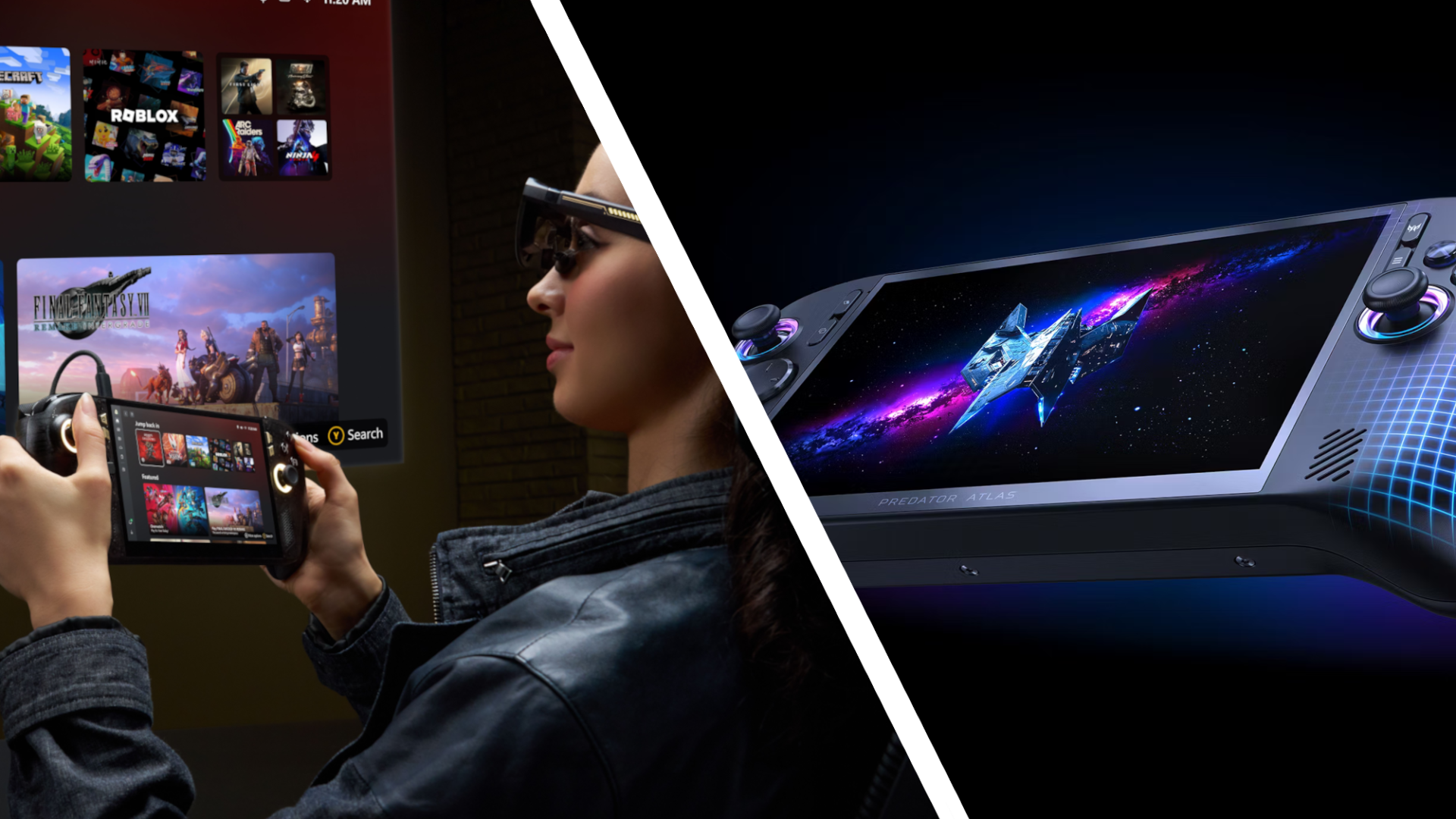
3. Asus ROG Xbox Ally X20

It’s quite clear that Asus has prioritized visual improvements over performance or power, so it’s hard to describe this as a ‘mid-generation’ upgrade, in the same way the Asus ROG Ally X was compared to its non-X counterpart.
The Xbox Ally X20 also features a rotatable D-pad, labeled a ‘Transforming D-pad’, which should cater to fighting game players when using the handheld, thanks to optimization for diagonal inputs.
The major downside is that Asus isn’t currently selling this as a standalone device, and since the ROG XReal R1 Edition 20 gaming AR glasses retail for $849, the bundle will likely be priced at or around $2,000.
4. Acer Predator Atlas 8

Just like the MSI Claw 8 EX AI+ and the OneXPlayer 3, the Acer Predator Atlas 8 is powered by Intel’s Arc G3 Extreme, with power-ready capabilities that can bolster performance in several games for users.
Its design takes after the Asus ROG Xbox Ally X (and the new ROG Xbox Ally X20), just as MSI has, with controller-like handles that cater to comfort for those long gaming sessions. The adjustable triggers on the Lenovo Legion Go S handheld are easily one of my favorite features for any handheld, and fortunately, that’s included here with the Atlas 8.
The only missing element is an OLED display for greater immersion, so it sits in a very similar ballpark as the Claw 8 EX AI+, with the only difference being the latter’s comfier design.
In the same vein as all of Computex’s handheld announcements, the Atlas 8 hinges on its price tag, and based on the current market conditions, thanks to the RAM crisis, it looks like it may be priced well above $1,000. Acer has confirmed that this will launch in October 2026, so price information shouldn’t be too far off.

Follow TechRadar on Google News and add us as a preferred source to get our expert news, reviews, and opinion in your feeds.