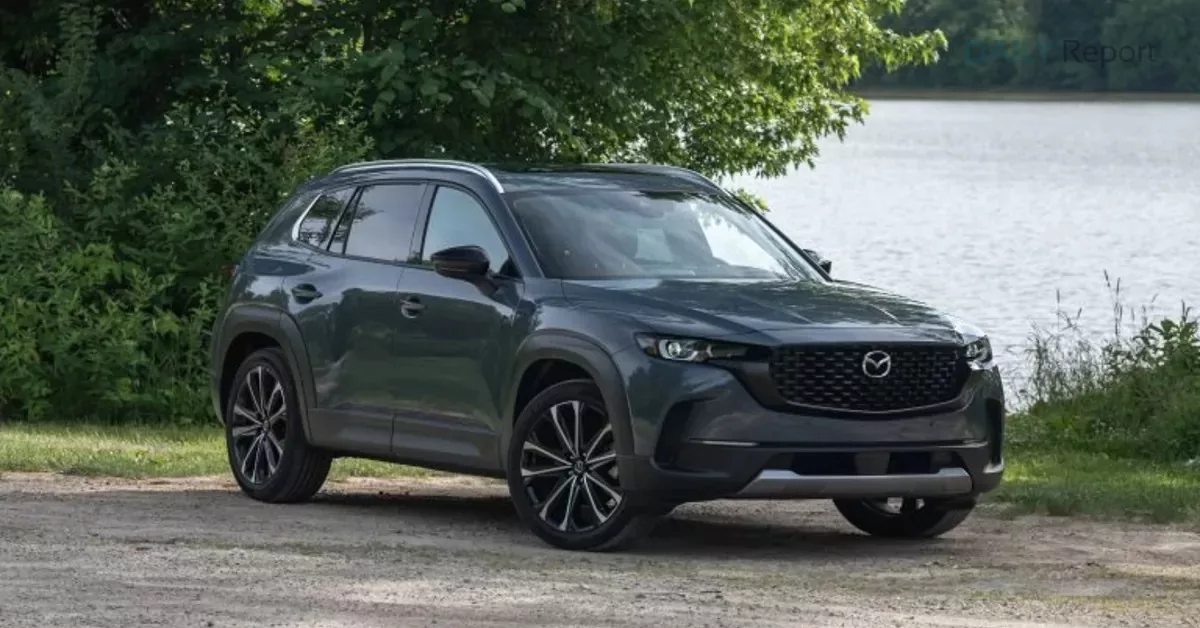
Mazda CX-50 2024
Mazda CX-50 2024
The base model now is the 2.5 S Select.
The more rugged and outdoor-focused Mazda CX-50, a brother of the CX-5, is starting its second year on the North American market. The 2024 CX-50 makes its appearance today with updated suspension and additional standard or optional features throughout the board. However, this has a higher MSRP than the 2023 model year.
The base 2023 CX-50 is priced at $28,025, making the current most inexpensive CX-50 much more expensive at $31,675 (with $1,375 destination included). The CX-50 2.5 S is no longer listed as the standard model by the manufacturer; instead, the CX-50 2.5 S Select, which comes with extra features, has taken its place. Nevertheless, the latter was $2,250 more expensive in 2024 than it was last year, with a starting price of $29,425. The price range for the CX-50 in 2024 is shown below.
Even the base CX-50 now includes amenities like a wireless 10.25-inch center display with Apple CarPlay and Android Auto connectivity, a dual-zone automatic climate control system, leather steering wheel, and gear shifter. To obtain heated sideview mirrors and windshield wipers, power boot lighting, and an eight-way electrically adjustable driver’s seat, upgrade to the CX-50 2.5 S Preferred Package.
All 2024 CX-50 cars will have new dampers installed by Mazda to improve the suspension of the vehicle. Additionally, customers receive an updated electric power-assist system, which is standard on all vehicles made starting in November of this year.There are a total of eight trim levels available for the updated SUV, with the CX-50 2.5 Turbo Premium Plus starting at $44,675 as the top model.
| Trim level | Price (includes $1,375 destination) |
| CX-50 2.5 S Select | $31,675 |
| CX-50 2.5 S Preferred | $33,025 |
| CX-50 2.5 S Premium | $35,375 |
| CX-50 2.5 S Premium Plus | $38,875 |
| CX-50 2.5 Turbo | $39,375 |
| CX-50 2.5 Turbo Meridian Edition | $42,175 |
| CX-50 2.5 Turbo Premium | $42,675 |
| CX-50 2.5 Turbo Premium Plus | $44,675 |
In the powertrain department, Mazda continues to sell the rugged family vehicle with a choice between two engines. The 2.5-liter mill can be had in either a naturally aspirated form with 187 horsepower and 186 pound-feet of torque or as a turbocharged mill with 256 hp and 320 lb-ft (when running on 93 octane gas). All models are equipped as standard with a six-speed automatic gearbox and Mazda’s i-Activ all-wheel-drive system.