“We’re not hiding how things work, we’re expressing it” — I sat down with Jake Dyson to talk radical product design, and why your favorite vacuum and hair dryer look like nothing else on the planet | Daily Reports Online
Whether it’s a vacuum cleaner, a hand dryer, an air purifier, or a fan, Dyson products rarely look like anything else on the market — and that’s particularly apparent at the company’s campus in Malmesbury, southwest England, where images of recent launches decorate the walls like modern art. The sprawling complex, in a particularly beautiful patch of Wiltshire countryside, is home to Dyson’s global Research, Design and Development (RDD) center, and the Dyson Institute, where students from around the world study while working alongside engineers on live projects. I visited the center to meet the company’s Chief Engineer Jake Dyson — son of founder Sir James Dyson — and learn more about the company’s approach to design.
Jake Dyson didn’t join his father’s business immediately; instead he set up a workshop and made a name for himself in the world of industrial lighting. Sitting in his office, I asked whether his experience in that sector had contributed to his work at Dyson today.
“Yes, it comes down to identifying problems and solving them,” he explained. “When LEDs first entered the market, I realized people weren’t cooling them properly. The promise of LEDs is that they should last a lifetime, but in reality they were being treated like disposable lightbulbs. I visited Osram in Asia, and they explained that if you keep the diode temperature below about 50C [120F, you can maintain brightness, color quality, and lifespan. That became my goal.
Latest Videos FromTechRadar
“I looked at how satellites manage heat. In space, temperatures swing from extremely hot to extremely cold, so they need precise thermal control. I applied similar thinking by designing systems that passively dissipate heat. For example, the heat moves away from the chip and is cooled by airflow, maintaining a stable temperature even at high power. That process, spotting a problem and solving it, is what drives everything.”
That problem-solving approach has always been the driving force behind the Dyson brand, and explains its unusual portfolio of products; its engineers have never been afraid to venture into new areas when there’s a problem to be solved.
“Sometimes it comes from frustration,” said Jake Dyson. “‘This product is rubbish, how can we make it better?’ Other times it’s curiosity: ‘Why does this work the way it does?’”
Problem-first design
James Dyson’s book Invention: A Life of Learning Through Failure, describes how the problem-first process led to the creation of many of the company’s most iconic and recognizable products — starting with a humble wheelbarrow. Dyson and his wife Deidre were renovating a house in Gloucestershire, England, and wanted to create a garden, but the traditional tools proved frustrating.
“I used a navy barrow in anger and its limitations became increasingly clear,” writes Dyson. “Cement slopped out of it. Its tubular legs sunk into the ground. It was hard to steer. Its sharp edges damaged doorframes. The more I used it, the more I realized that nobody had really thought about these problems or bothered to fix them.”
After much experimentation with shapes, materials, and manufacturing processes, the result was the Ballbarrow: a molded plastic bucket on a steel frame, with the conventional wheel replaced by a pneumatic ball made from EVA (ethylene-vinyl acetate). This spread the weight of the load more evenly on soft ground, and was easier to maneuver than a wheel — and in bright orange, it looked unlike anything else at the time.

The product itself was a success, but due to a series of poor business decisions, Dyson senior eventually lost control of the company he had founded around it, Kirk-Dyson, and was ultimately kicked out by the other shareholders.
“I had lost five years of work by not valuing my creation,” he wrote. “I had failed to protect the one thing that was most valuable to me.”
It was a painful experience, but one he learned from as he pressed on with identifying and solving problems — starting with the creation of the first cyclonic vacuum cleaner, which he designed after realizing that dust bags don’t just serve to collect dust — they also act as filters that block airflow, drastically reducing suction power.
“I remembered the same clogging problem on the calico cloth with the powder coating in the Ballbarrow factory and the giant cyclone we had made to solve it,” he wrote. “What if I could develop a much smaller version and replace the clogging bag in a vacuum cleaner?”
Thousands of prototypes later (5,127 to be precise), he had the world’s first bagless vacuum — and a vast collection of patents to protect it.

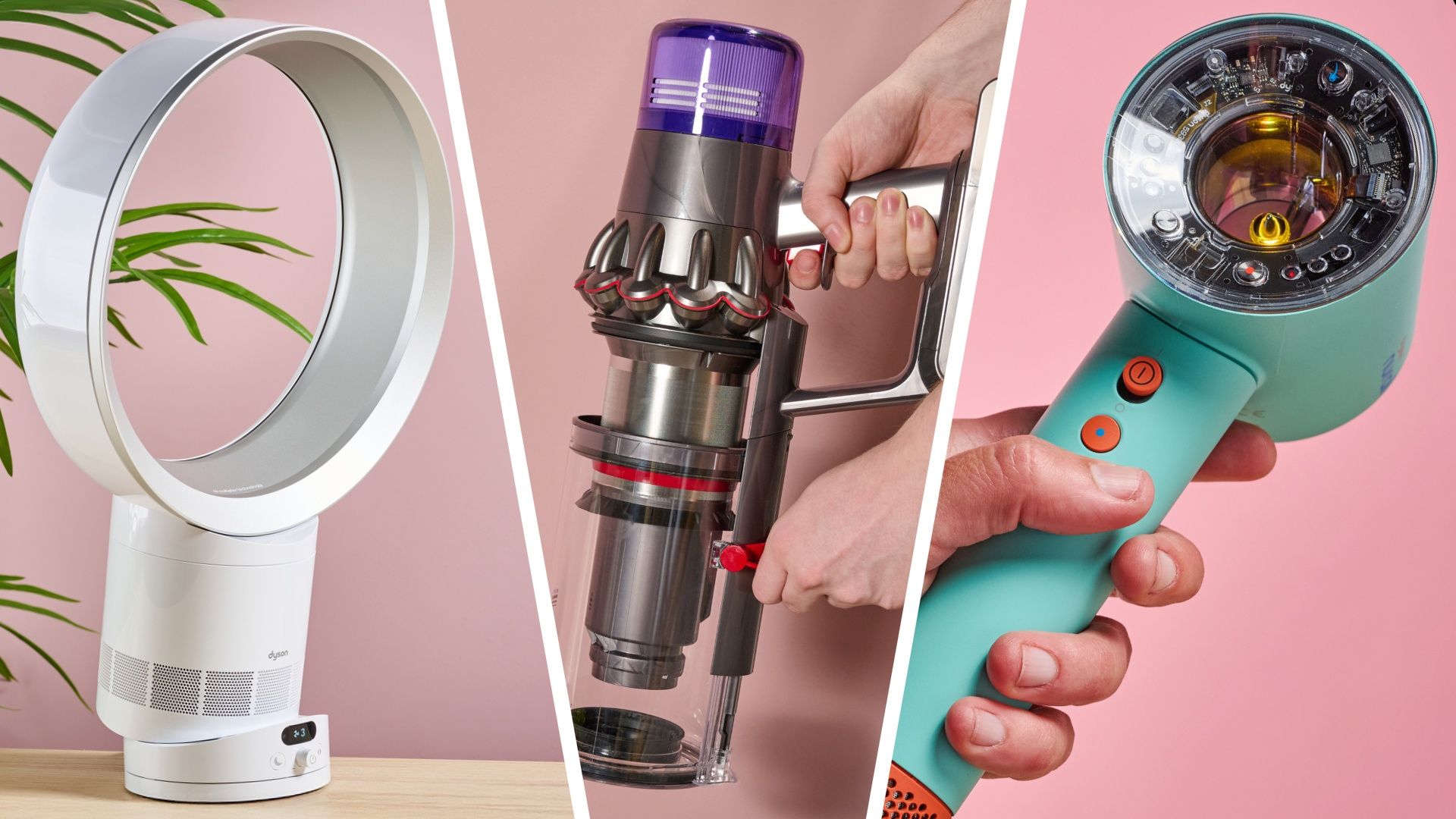
Dyson’s understanding of airflow and cyclonic technology has informed almost all of the company’s subsequent products; but like the vacuum, each one started with a problem. The Dyson Airblade hand dryer was created to reduce waste paper towels; the Airmultiplier fan solved the issue of ‘choppy’ air from conventional fan blades; the Pure Hot+Cool purifier was made to tackle indoor air pollution; and the Supersonic hairdryer solved the problem of heavy and uncomfortable hairdryers with weighty motors.
In every case, the form of the finished product was dictated by the problem it was designed to solve — even if the result looked totally unlike established versions of the device.
“That’s why Dyson products often look unusual; they’re built around their function,” said Jake Dyson in his Malmesbury office. “They’re also beautiful. A hair dryer has a hole through it because of how the airflow works. Fans and other products expose their engineering principles through the way they look — we’re not hiding how things work, we’re expressing it.”
Creative color
Those unusual designs are often set off by equally unusual color schemes, which tend to highlight buttons, switches, removable canisters, and other functional parts.
“We have a team here, CMF, which is colors, materials and finishes, that look into the appearance but also materials of our products,” said Jake Dyson.
The CMF team doesn’t just draw on experience from successful projects, but also failed ones like the cancelled Dyson electric car, which provided finish and material ideas for many of the company’s health and beauty devices.
Most recently, CMF lent its expertise to Dyson’s first hand-held fan — the Dyson HushHet Mini Cool — which launched just in time for a series of heatwaves in the UK. It sold out almost immediately, and after testing it myself, I can see why; it’s compact, much more powerful than its closest rival, the Shark ChillPill, and more affordable to boot.
“We’ve seen strong demand [for the HushHet Mini Cool], and it’s one of those products where people don’t initially realize they need it but once they try it, they understand the value,” said Jake Dyson. “It’s designed to be reusable, not disposable like cheaper alternatives. I’ve seen people with the cheap plastic fans that break very [easily], but we wanted ours to be well engineered, durable, quiet and efficient.

“We’re working on scaling production, but demand has been very strong, so availability can sometimes be limited. That said, it is coming back to market.”
So what does the future hold? The company is investigating ways to use AI where it will actually add value, helping machines interpret data and make better decisions, and Jake Dyson says that “vision systems and new product directions” are the most exciting areas for him.
“We’ve historically been very strong in mechanical engineering motors, airflow, performance. But now, adding cameras and vision systems allows machines to detect what they’re looking at, understand it and act accordingly.
“That opens up entirely new categories of products and capabilities, so we’re moving from purely mechanical devices to machines that can see, think, and respond, and that’s where the next wave of innovation is coming from.”
It’ll be fascinating to see which problems the company will be looking to solve with those new technologies, and there’s no way of knowing what the next generation of Dyson products will look like as the company expands into new areas. We’ll just have to wait and see — but it’s definitely not going to be boring.

Follow TechRadar on Google News and add us as a preferred source to get our expert news, reviews, and opinion in your feeds.