Zotac squeezes a desktop RTX 5080 into a tiny PC, but the barebones price starts above $2,600 | Daily Reports Online
- Zotac Magnus One Ultra’s Core Ultra 7 265 delivers 20 cores and speeds of up to 5.3 GHz
- Nvidia rates the desktop RTX 5080 at 1,801 AI TOPS for artificial intelligence workloads
- The desktop GPU features 10,752 CUDA cores, 336 Tensor cores, and 84 RT cores
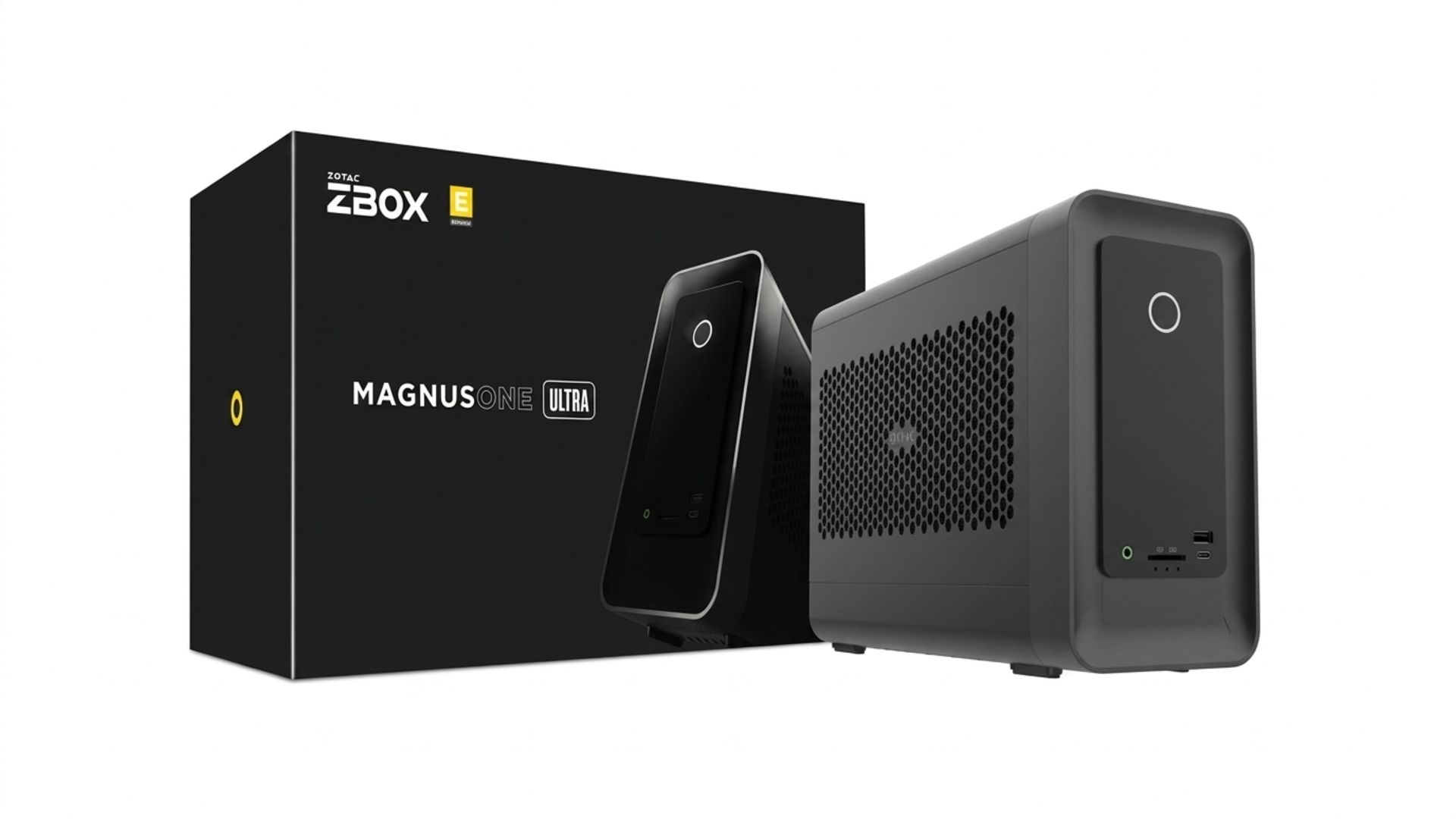
Zotac has released a compact desktop computer built around Nvidia’s GeForce RTX 5080, with barebones pricing starting at approximately ~ $2,640 in Japan.
The Magnus One Ultra EU275080C combines a desktop graphics card with Intel’s Core Ultra 7 265 processor inside an 11.46L enclosure.
The 20-core processor runs at 2.4GHz and boosts up to 5.3GHz, and Zotac says the device is one of the smallest PC to pair a desktop RTX 5080 with a desktop Intel Core Ultra chip.
Latest Videos FromTechRadar
Desktop RTX 5080 power comes in a compact enclosure
The system uses Nvidia’s Blackwell architecture and supports DLSS 4.5 with Multi-Frame Generation, ray tracing, 4K gaming and local artificial intelligence workloads.
Its desktop RTX 5080 includes 16GB of GDDR7 memory, distinguishing it from compact computers that rely on integrated graphics or mobile GPUs.
The memory runs on a 256-bit bus with 960GB/s of bandwidth, alongside 10,752 CUDA cores, 336 Tensor cores and 84 RT cores.
Nvidia rates the GPU at 1,801 AI TOPS, and it is considered to be about 33% ahead of the RTX 4080 in games.
Nvidia also sells laptop RTX 5080 graphics hardware, but those mobile components are not equivalent to the desktop version.
Zotac fits the hardware inside a chassis measuring 126 x 365.5 x 249 mm, with a total weight of approximately 6.34 kg.
An 850W power supply supports the configuration, while the system offers two memory slots accommodating compatible DDR5 modules and a maximum capacity of 96GB.
The GPU’s 360W rating takes about 42% of that supply, and memory is rated at DDR5-6400 for CSODIMM and 5600 for SODIMM.
Storage expansion comes through two M.2 slots, supporting PCIe 5.0 x4 and PCIe 4.0 x4 connections respectively.
The connectivity options include Thunderbolt 4, Wi-Fi 7, Bluetooth 5.4 and eight USB connections (four USB 3.2 Gen 2, four USB 3.2 Gen 1) for peripherals and external devices.
Display outputs comprise three DisplayPort 2.1b connectors, one HDMI 2.1b port, one HDMI 2.0 connection, and a DisplayPort-compatible Thunderbolt 4 port.
Together, these connectors support up to six total displays — or four simultaneous 4K displays driven directly by the dedicated graphics card.
With compatible displays and Display Stream Compression, DisplayPort 2.1b supports configurations reaching 4K at 480Hz or 8K at 165Hz.
The HDMI 2.1b output supports up to 4K at 480Hz or 8K at 120Hz, depending on the connected display and configuration.
Network connectivity includes one 5Gbps Ethernet port and one 1Gbps Ethernet connection, alongside a UHS-II SD card reader and audio inputs.
Barebones pricing leaves buyers to configure the system
Zotac lists several configurations, with Japanese direct-sale prices ranging from ¥418,000 (~$2,647) to ¥750,200 (~$4,750) depending on memory, storage, and operating system.
The entry-level package excludes all three, which means that users interested in this model will have to separately purchase the memory, storage and OS.
A version with 16GB of memory and a 1TB SSD costs ¥522,500 (~$3,309) with Windows 11 Pro installed.
The model with 32GB or 64GB of RAM and a 1TB drive costs ¥561,000 (~$3,552) and ¥654,500 (~$4,144), respectively, while the highest-priced option includes 96GB of memory for ¥750,200 (~$4,750).
There is also a Windows version of the Zotac Magnus One Ultra that comes with 32GB of RAM and two 1TB SSDs and costs ¥588,500 (~$3,727).
Via PC Watch (originally in Japanese)
Follow TechRadar on Google News and add us as a preferred source to get our expert news, reviews, and opinion in your feeds.